





AI, PRIVACY, AND PROFESSIONAL RESPONSIBILITY: WHO ARE WE TRUSTING?
October 21, 2026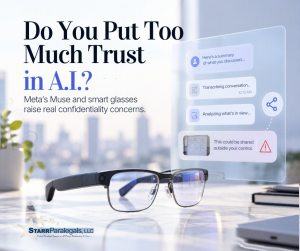
My friend Jennifer Ellis, an attorney and respected authority on legal ethics and technology, shared some disturbing information about Meta’s AI products. It’s worth reading, and it’s worth discussing.
Security researchers discovered that approximately 6,800 conversations shared through Meta’s new Muse AI assistant could be located through publicly accessible DNS records. Some contained confidential business information, financial details, internal reports, and other sensitive material. Information that users presumably never intended to make publicly discoverable. Meta has reportedly suspended the sharing feature while investigating.
Jennifer also raised concerns about Meta’s smart glasses, which have been the subject of separate investigations into privacy, recording practices, and access to personal footage.
These aren’t simply technology stories. They’re reminders of how easily convenience can outrun common sense, privacy, and professional responsibility.
And the concerns extend well beyond Meta.
We’re increasingly relying on artificial intelligence to research, write, communicate, manage information, and make decisions. But AI can hallucinate, fabricate citations, misinterpret instructions, and produce responses that sound authoritative while being completely wrong. Add the potential exposure of confidential information, and the consequences can be significant.
The responsibility doesn’t disappear because a machine did the work.
When we engage attorneys, paralegals, accountants, consultants, or other professionals, we’re placing our trust in their judgment, experience, and ability to safeguard information. We should also be asking how they use AI, what information they’re sharing with it, whether their work is independently verified, and what safeguards are in place.
Those questions are just as important for professionals evaluating the people they hire to assist them.
As someone who has spent more than four decades in the legal profession, including years working in paralegal ethics, I believe technological competence and ethical responsibility go hand in hand. Knowing how to use a tool is only part of the equation. Knowing when NOT to use it is equally important.
At StarrParalegals, LLC, professional responsibility isn’t an afterthought. It’s part of how I approach the work and the relationships I’ve built with attorneys over the years.
I use AI. I recognize its value. I also recognize its limitations, and I don’t believe we should surrender our judgment simply because technology promises to make our lives easier.
Trust is earned. Confidentiality is essential. And accountability remains human.
My thanks to Jennifer Ellis for raising these concerns and encouraging the conversation.
Ars Technica reporting: https://arstechnica.com/security/2026/10/meta-muse-exposes-users-personal-and-business-secrets-when-they-share-conversations/
Jennifer’s website: https://jlellis.net/
